

Brandon White’s stunning debut not only grabs you from the first and doesn’t let go. It hurls you emotionally into its titular “older than ghosts” universe and blocks the door.
Our blazing shock, as readers, feels only a little less searing than what the young protagonist faces in the book’s first pages.
Thirteen-year-old Daniel—rendered in the prologue’s punchy, smoke-inhaling prose—must fight not only for his own life, but that of his mother, as they try to flee a burning house and an abusive man in Mississippi.
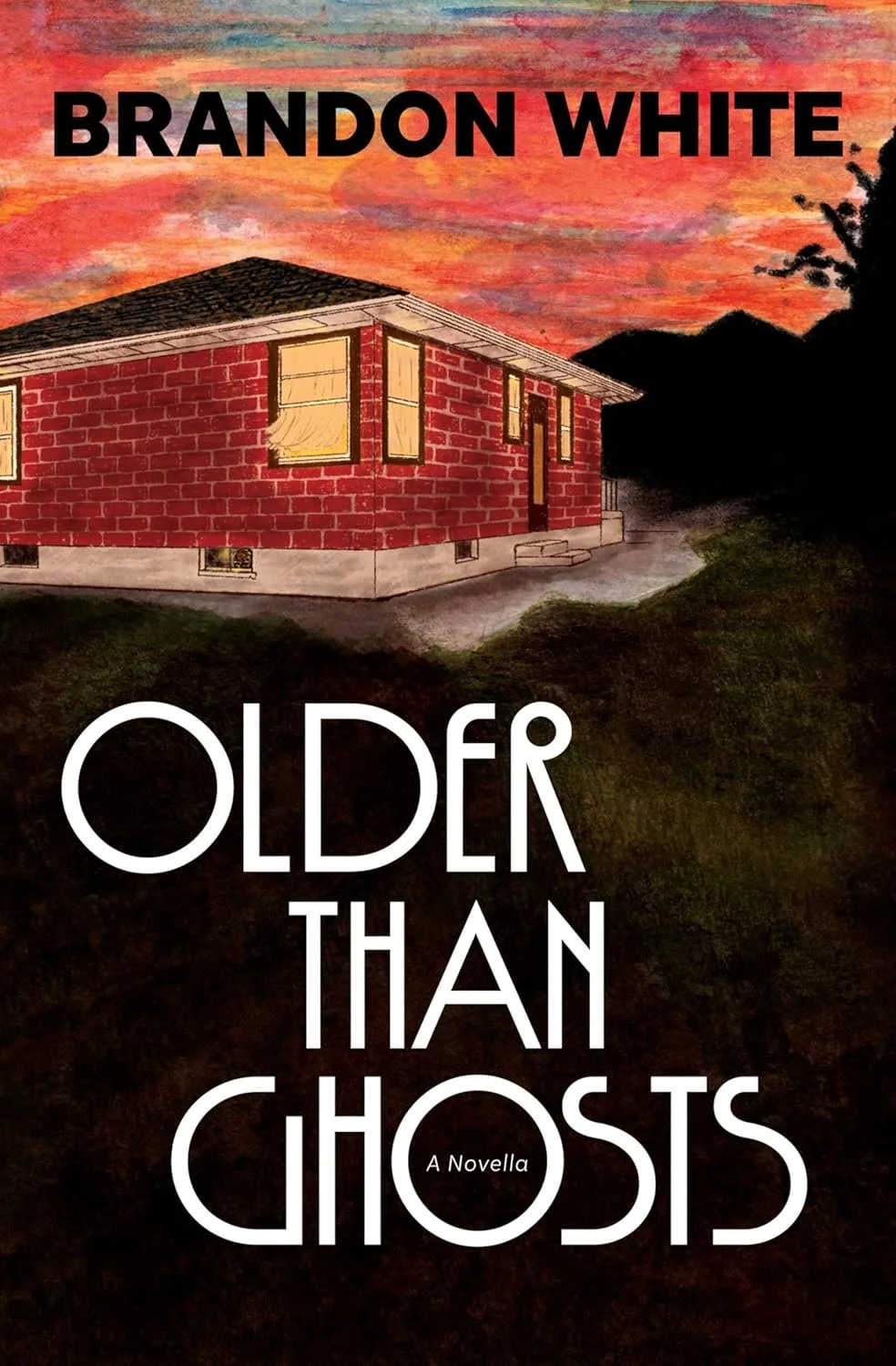
Credit: Lanternfish Press
As if acting out a metaphor for his mother’s inability to help herself, Daniel must physically drag the thin, injured woman from her bed, pull her and himself from a conflagration, and, eventually, get themselves to a northern-bound Greyhound bus:
Grab that rail. Pull hard with the right arm. Left leg, limp, protests—drags across frayed carpet.
While we don’t know who the man is, it’s clear he’s malevolent and violent, and a threat to everything Daniel holds dear.
Daniel likens him to the Devil and swears vengeance on the man and “his demons” if they ever pursue him and mother; he even prays the man “wakes up in sheets of flame” from the house fire that Daniel apparently set.
The Mississippi where the novella opens is a long way from Yoknapatawpha County or Milledgeville, Georgia, but its Black Southern Gothic psychogeography shares the same mysterious, subterranean sense of being a deeply haunted landscape as the works of William Faulkner and Flannery O’Connor:
They walked past trees that seemed to be melting in the Mississippi springtime humidity. The same wetness seemed to dampen the sound of them … Haze shrouded the streetlamps, and porch lights looked like distant matches lit in forgotten cemeteries.
Still, Older Than Ghosts both looks back deeper than Faulkner—and more fully ahead to today. White is totally comfortable in the late 1990s pre-social media era setting we often inhabit in Older Than Ghosts, and much of the story limns spaces that will feel familiar to the working poor of America back then—a world of convenient store meals of jerky and cheese combos, Aldi, duffel bags and bus stations, Gatorade, and the scent of Nag Champa.
Soon after Daniel and his mother make their way to relatives “up South” in the South Side of Chicago—once “labeled the Second Mississippi,” as White puts it—we’re brought into a larger, more transhistorical universe of successive migrations of Black Americans from the Deep South to the the North, many driven by racial and economic injustice, and the spiritually and geographically dislocating currents of slavery.
The combination of acceptance, lingering poverty, and urban alienation give the Chicagoland of Older Than Ghosts a complex double-edged power for Daniel.

Author Brandon White. Photo credit: Michelle Holbert/Lanternfish Press
There’s a restlessness in almost all the characters of the book. It keeps them moving physically and narratively, and for White, as a writer, poetically.
Images of melting, fading, and things blowing away like ash in the air seem to flutter down onto almost every page of this lyrical volume. That painful kinesis feels intentional.
Before Daniel really has a chance to settle and regain composure with his mother in Chicago, she returns to the South, leaving him with his older relatives. Against their counsel, Daniel decides to seek to rescue his mother.
But here Daniel gains unexpected help—and a deeper understanding of himself. As if brought into consciousness by the critical mass of personal and historical pressures we see in this teenager’s life, a supernatural “entity”—a being connected to the deepest needs of the African diaspora in America—awakens and comes to his aid.
Older Than Ghosts is both heartbreaking and inspiring. It is impossible not to feel Daniel’s desperation and desire to believe in something better, and while there are many ways to interpret the meaning of the powerful entity who comes to take over Older Than Ghosts, I see it as a creative if very dangerous force of redemption.
The novella leaves you pondering more than the tragic story of one boy forced to become the protector of his mother. When you emerge as a reader, like a sleeping traveler on one of the story’s many buses in a fever dream, you not only feel transformed, but you exit into a different place than you began.
With its slowly unfolding depth and vivid cultural relevance for today, the story has “film adaptation” all over it, and one can only hope it gains the audiences the story merits, in whatever form it takes.
A graduate of the University of Houston’s prestigious MFA program in creative writing, White has developed a unique and profoundly compelling voice that feels like one the times have finally caught up to.
That White’s own journey has taken him from Chicago to Texas to New York City and back to the South makes sense, and it’s easy to see some of White in Daniel’s imaginative restlessness and creative drive for meaning. He’s not finally in this debut too interested in scary stories or even ghosts. He’s interested in the healing of broken selves.